

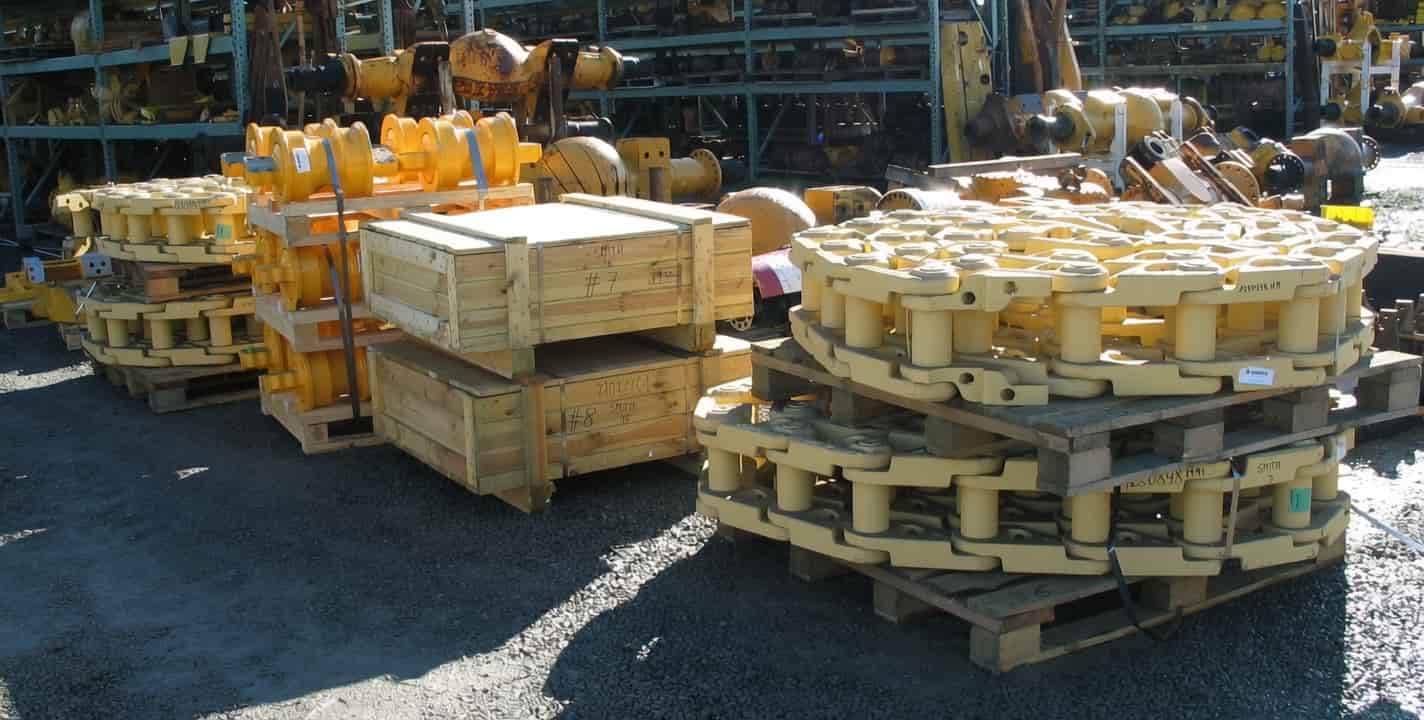
Matching the right undercarriage is critical for performance, safety, and longevity — we stock millions of components ready to ship.
At FP Smith Parts & Equipment, we stock millions of parts for Komatsu, Caterpillar, John Deere, Dressta, International Harvester, and many other makes. Matching the right undercarriage components is critical for performance, safety, longevity, and minimizing downtime. A mismatch can lead to accelerated wear, track derailment, sprocket damage, higher operating costs, and even safety risks.
This comprehensive guide walks you through identifying the correct undercarriage for your dozer, excavator, track loader, or other crawler machine. We’ll cover key specifications like pitch, track link count per side, sprocket teeth count, track pad (shoe) width, bolt diameter, and bolt pattern (inline or staggered), with practical measurement tips, examples, nuances, and considerations.
Why Accurate Undercarriage Matching Matters
Undercarriage systems represent 20-50% of a machine’s total operating costs over its life. Proper fit ensures:
- Optimal traction and flotation.
- Even wear distribution.
- Compatibility with rollers, idlers, and final drives.
- Compliance with OEM specs for warranty and performance.
Factors like application (abrasive mining vs. general construction), terrain, machine hours, and maintenance history influence choices. We offer OEM surplus, quality used, reconditioned, and aftermarket options to balance cost and durability.
Step 1: Gather Basic Machine Information
Start here before measuring:
- Make, Model, and Serial Number: Locate on the machine (often on the frame, cab, or boom). This is the fastest way to reference OEM manuals or our inventory.
- Machine Type: Dozer (elevated/low sprocket), excavator, track loader, etc. — affects component design.
- Current Part Numbers: Check existing links, shoes, or sprockets for stamped numbers.
- Operating Conditions: Rocky/abrasive? Wet/muddy? High-impact? This guides material grade (e.g., heavy-duty vs. general duty).
Contact us with this info for quick recommendations — same-day shipping on most stocked items before 3 PM.
Step 2: Key Measurements and Specifications
Use tools like a tape measure, calipers, depth gauge, and ultrasonic wear tools for precision. Measure on a flat, clean section; take multiple readings and average them. Always measure both sides, as wear can differ.
1. Track Pitch
Definition: Center-to-center distance between adjacent track pins or drive lugs (in mm or inches).
Why it matters: Must perfectly match the sprocket tooth spacing. Even small mismatches (a few mm) cause poor engagement, slippage, noise, and rapid failure of links, bushings, and sprockets.
How to measure:
- For steel tracks: Measure across 4-5 pins (center to center), then divide by the number of pitches spanned for accuracy (avoids single-pin wear error).
- For rubber tracks: Center-to-center between drive lugs.
- Common values: 52.5mm, 72mm, 86mm, 90mm, 175mm+, depending on machine size.
Nuance: Worn tracks “stretch” (elongate pitch). Compare to new specs. Elevated sprocket machines (e.g., many Cat dozers) have unique dynamics.
2. Track Link Count per Side
Definition: Total number of track links (or segments) in one full track chain.
Why it matters: Determines overall track length and fit within the undercarriage frame. Wrong count causes improper tension, sag, or binding.
How to measure: Count links around the entire track (mark starting point with chalk/tape). Typical ranges: 30-50+ for smaller machines, higher for large dozers.
Tip: Link count pairs with pitch and gauge for full sizing (e.g., similar to rubber track notation like 450x86x56).
3. Number of Teeth on Sprocket
Definition: Count of drive teeth (or pockets) on the sprocket.
Why it matters: Directly interacts with track pitch and link design. Mismatch accelerates wear on both.
How to check: Visually count or consult machine specs/part numbers. Common: 20-40+ teeth.
Consideration: Inspect sprocket condition (hooked/pointed teeth indicate wear from stretched tracks). We stock sprockets and segments.
4. Track Pad (Shoe) Width
Definition: Width of individual track shoes/pads (often in mm or inches).
Why it matters: Affects ground pressure, flotation, and stability. Narrower for hard/rocky terrain or transport; wider (LGP – Low Ground Pressure) for soft/wet ground.
How to measure: Outer edge to outer edge of the shoe.
Examples: 300mm (mini-ex), 450mm+ (larger machines), up to 1m+ for mining.
5. Track Pad Bolt Diameter
Definition: Diameter of the bolts securing shoes to links.
Why it matters: Ensures secure fastening and load handling. Wrong size leads to loosening or breakage.
How to measure: Use calipers on existing bolts or holes. Common: 5/8″, 3/4″, M16, M20, etc.
Pro Tip: Always replace bolts/nuts with matching grade (high-strength for heavy applications).
6. Track Pad Bolt Pattern: Inline or Staggered
Definition:
- Inline: Bolts aligned in straight rows/columns.
- Staggered: Offset (zigzag) pattern for better load distribution and strength.
Why it matters: Affects compatibility with link holes and overall joint integrity. Staggered often provides superior performance in high-stress conditions.
How to identify: Inspect the shoe or link bolt holes. Count bolts per shoe (typically 2-9+) and note arrangement.
Nuance: Some machines use specific patterns; mixing can cause uneven stress or cracking.
Additional Considerations and Edge Cases
- Track Gauge: Distance between track centers (sprocket-to-sprocket measurement) — critical for frame fit.
- Wear Assessment: Measure rail height, grouser height, bushing/pin wear, roller/idler diameters. We can help interpret or supply rebuild kits.
- Rubber vs. Steel Tracks: Rubber uses similar width/pitch/link metrics but different engagement.
- OEM vs. Aftermarket: OEM for precision; high-quality alternatives (often from surplus) for value. We specialize in hard-to-find parts.
- Environmental/Regional Factors: In California or export markets, consider ground conditions, regulations, and shipping.
- Tension and Alignment: Proper sag/adjustment is vital post-install.
- Complete System Approach: Replace links, shoes, sprockets, rollers, and idlers together for balanced life.
Edge Cases: Older/vintage machines (e.g., IH, Allis-Chalmers), modified equipment, or mixed-brand fleets require extra verification. High-hour machines or extreme applications may need heavy-duty or sealed-and-lubricated options.
How FP Smith Parts & Equipment Can Help
With decades of expertise, a massive physical inventory in Fairfield, CA, and parts for Komatsu, Cat, John Deere, and more, we get you the right parts the first time. Whether it’s a full undercarriage kit, individual components, or rebuild support, our team assists with identification, pricing, availability, and technical advice.
Call us today at our Fairfield location or visit www.fpsmithparts.com to search our catalog. Provide your machine details and measurements for fast quotes and same-day shipping (cutoff 3 PM). Explore our growing selection of exploded views and parts diagrams